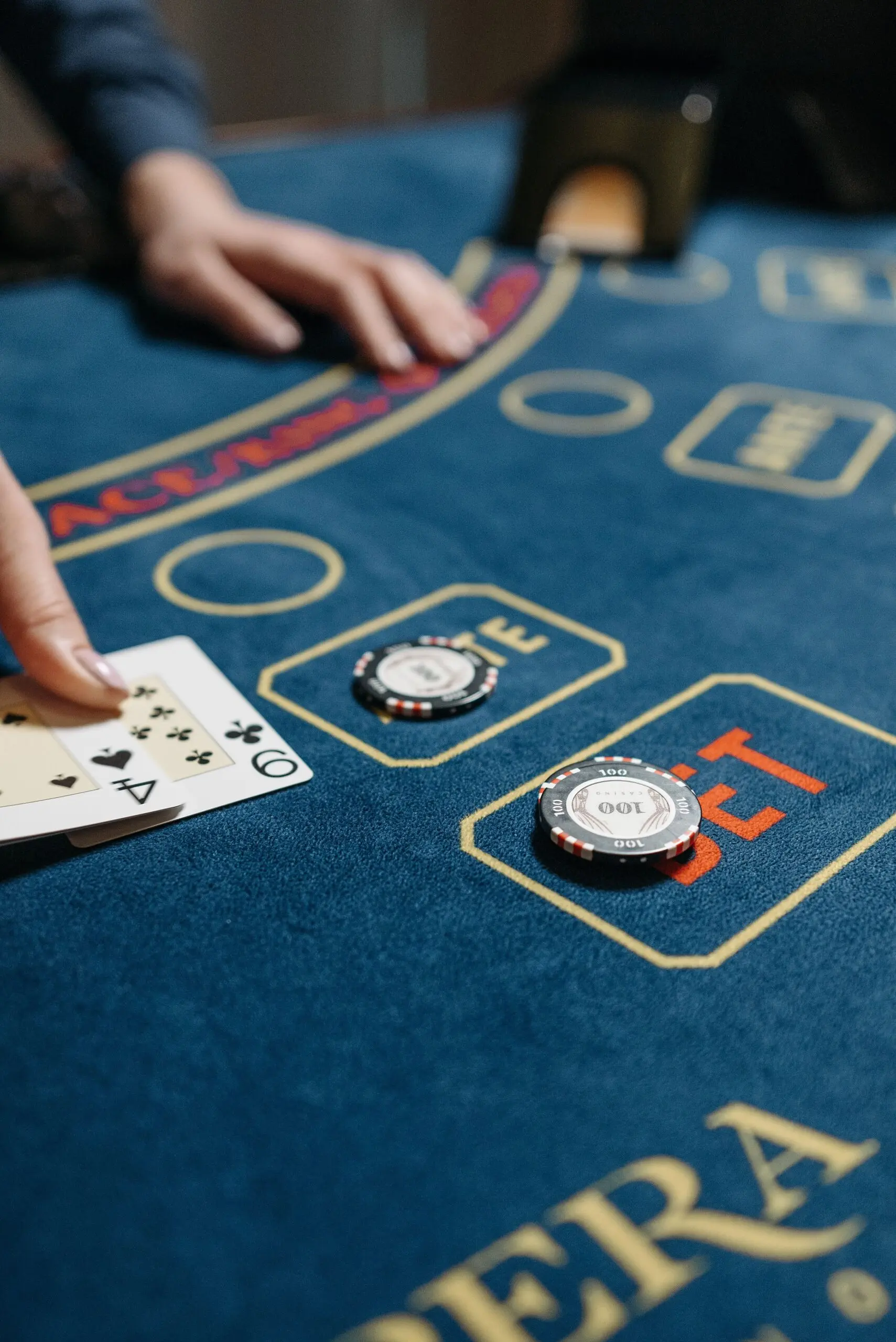
Baccarat has a luxury image, but the basic game is one of the simplest table games in the casino. Players do not decide whether to hit or stand. They choose a wager—usually Banker, Player, or Tie—and the cards are dealt according to fixed drawing rules.
That simplicity hides an important fact: baccarat contains both some of the best and some of the worst common bets on a casino floor. The standard Banker wager has a house edge of roughly 1.06% under conventional commission rules. Player is around 1.24%. A standard Tie bet can carry a double-digit house edge depending on the payout.
This guide explains baccarat house edge, Banker commission, Player bets, Tie bets, no-commission baccarat, card-drawing rules, side bets, scoreboards, patterns, bankroll management, comps, and why the best baccarat strategy is mostly about choosing the right wager and avoiding expensive distractions.
How Baccarat Works
Two hands are dealt: the Player hand and the Banker hand. Those labels do not represent the casino and the customer. They are simply the names of the two betting positions.
Cards are valued by their final digit. Aces count as one, 2 through 9 count at face value, and 10s and face cards count as zero. Totals above nine drop the tens digit. A hand totaling 15 therefore has a baccarat value of 5.
The hand closest to 9 wins.
You Do Not Control the Draw
Baccarat uses fixed third-card rules. Players do not make blackjack-style hit or stand decisions.
This is important because strategy in baccarat is not about playing the hand correctly. The main strategic decision is which wager to make.
The Banker Bet
Under standard baccarat rules, Banker wins slightly more often than Player because of the drawing rules. Casinos usually charge a 5% commission on winning Banker bets to preserve the house advantage.
The resulting house edge is approximately 1.06%, making Banker one of the stronger standard wagers in a casino.
The Player Bet
Player wins slightly less often than Banker but usually pays even money with no commission. The house edge is roughly 1.24% under common rules.
That is still low compared with many roulette wagers, slot configurations, carnival games, and side bets.
The Tie Bet
The Tie wager looks attractive because the payout can be 8 to 1 or 9 to 1 depending on the table. The probability is much lower, and common payout structures create a large house edge.
At an 8-to-1 payout, the house edge is often quoted around 14.36% for standard eight-deck baccarat. Exact math depends on rules.
This is why serious baccarat players usually avoid treating Tie as a regular wager.
Banker vs Player: Which Is Better?
If your only objective is minimizing house edge under standard rules, Banker is generally the strongest base wager. Player is close behind and avoids commission accounting.
The difference is small in one hand but meaningful over large wagering volume.
Why Banker Wins More Often
The Banker hand acts after the Player hand under the third-card rules and can sometimes use information from the Player’s third card. This structural advantage creates the slightly higher win probability.
The casino offsets that advantage by charging commission on Banker wins.
How Banker Commission Works
At a traditional table, a winning $100 Banker wager may produce $95 in profit after a 5% commission. Some tables track commission during play and collect it later; others deduct it immediately.
Procedures vary, but the purpose is the same: reduce the payout enough to create the standard house edge.
No-Commission Baccarat
No-commission variants remove the standard 5% fee but change the payout on certain Banker outcomes, commonly a Banker win with a specific total such as 6.
This makes the game easier operationally but changes the math. Do not assume “no commission” means lower house edge.
Check the exact payoff rule.
EZ Baccarat
EZ Baccarat is a popular commission-free variant that uses special rules to handle certain Banker wins and may include optional side bets. The base game can remain competitive, but side bets can carry much larger edges.
Always separate the main Banker/Player math from promotional side wagers.
Mini Baccarat vs Big Baccarat
Mini baccarat uses the same essential drawing rules but is dealt on a smaller table at a faster pace. Traditional high-limit baccarat can be slower and more ceremonial.
The pace difference matters. Faster games create more decisions per hour, increasing total wagering and expected dollar loss even if the house-edge percentage is unchanged.
Expected Loss in Baccarat
Expected loss is total action multiplied by house edge.
If you wager $10,000 total on Banker at roughly 1.06%, theoretical loss is about $106. The same $10,000 on Player at 1.24% is about $124.
If a Tie wager carries a 14%+ edge, the theoretical cost can be more than ten times larger.
Why Baccarat Can Be Expensive Despite a Low House Edge
Baccarat often attracts high-limit players. A 1% edge sounds small until the average bet is $1,000 and the player makes dozens of wagers per hour.
At high volume, even a low percentage produces large expected dollar value for the casino.
Baccarat Scoreboards
Many baccarat tables display roads and scoreboards such as the Big Road, Big Eye Boy, Small Road, and Cockroach Pig. These displays organize previous results into patterns.
They can be entertaining and useful for recording history. They do not prove that future independent outcomes must follow the visual pattern.
Does Banker Become Due After Many Player Wins?
No. A streak does not create a debt that the shoe must repay immediately.
The next hand’s probabilities are determined by the remaining shoe and game rules, not by a requirement to balance the scoreboard.
Is Card Composition Relevant?
Baccarat is dealt from a finite shoe, so exact probabilities can shift slightly as cards are removed. Advanced researchers have studied composition-dependent effects and side-bet counting.
For ordinary players, these shifts are generally too small and difficult to exploit without specialized methods. Pattern betting is not the same as mathematically tracking card composition.
Baccarat Side Bets
Casinos offer many side bets because they add excitement and can carry much larger house edges. Examples can include Dragon, Panda, pairs, perfect pairs, lucky totals, and other proprietary wagers.
Payouts vary by game. Always check the pay table before making a side bet.
Why Side Bets Look Attractive
Side bets advertise large payouts: 8 to 1, 11 to 1, 25 to 1, 40 to 1, or more. The big number draws attention, but payout size does not tell you value.
You need the true probability of the event and the offered payout. A rare event paying 25 to 1 can still be a terrible bet if fair odds would require 40 to 1.
Baccarat vs Roulette
Standard Banker and Player bets have lower house edges than double-zero and triple-zero roulette. Single-zero roulette is also typically more expensive than Banker or Player under ordinary rules.
If the only objective is minimizing house advantage, baccarat base bets are strong choices.
Baccarat vs Blackjack
Good blackjack rules combined with correct basic strategy can produce a house edge lower than baccarat. But blackjack requires decisions and mistakes increase the edge.
Baccarat requires almost no playing decisions after the wager is placed. That simplicity makes it attractive to players who do not want to memorize strategy charts.
Baccarat vs Slots
Slot RTP can vary widely. A 96% RTP slot has a 4% theoretical casino edge before considering progressives and other factors, much higher than the standard Banker bet.
Slots provide different entertainment and jackpot potential, but baccarat can be cheaper mathematically per dollar wagered.
Does Betting Banker Every Hand Guarantee Profit?
No. A low house edge is still a house edge. Short-term variance can produce long losing streaks.
Betting Banker every hand minimizes the disadvantage relative to many other baccarat bets, but it does not create a positive expectation.
The Martingale in Baccarat
Players often apply Martingale to Banker or Player, doubling after losses.
The problem is identical to roulette: losing sequences cause exponential bet growth. Table limits and finite bankroll eventually stop the progression.
No staking system changes the house edge of the underlying wager.
Flat Betting
Flat betting means using the same wager size repeatedly. It does not beat the casino, but it prevents the explosive risk created by progression systems.
For bankroll control, flat or modest variable betting is easier to manage than doubling systems.
Bankroll Management
Choose a unit size small enough that normal variance cannot eliminate the entire session quickly.
A $1,000 bankroll with $100 wagers provides only ten raw units. Baccarat can easily produce a streak longer than expected. A smaller unit provides more runway.
Stop-Loss and Stop-Win Limits
A stop-loss does not change expected value, but it caps session damage. A stop-win can protect a large short-term gain from being re-wagered.
Set limits before play, not after emotions change.
High-Limit Baccarat
Baccarat is one of the most common games in high-limit rooms. Casinos may offer private tables, premium service, hosts, lounges, and larger credit lines to valuable baccarat customers.
Those benefits do not reduce the mathematical edge unless the rules or promotions actually improve value.
Baccarat Comps
Casinos rate baccarat using average bet, time, game pace, and a theoretical edge assumption. Because high-limit baccarat can generate enormous total action, players can earn significant comps despite the relatively low house edge.
Compare the value of those comps with the expected cost of play.
Commission Tracking and Player Experience
Traditional commission baccarat can create operational friction because dealers must track amounts owed. Some players prefer no-commission games for speed.
Faster speed means more wagers per hour, so convenience can increase total expected loss.
Online Baccarat
Regulated online casinos often offer RNG baccarat and live-dealer baccarat. Minimum bets can be lower than high-limit physical tables.
Online speed can be much faster. A low house edge does not protect you if you dramatically increase total wagers.
Live Dealer Baccarat
Live dealer games recreate much of the physical experience with a real dealer and video stream. They can slow the game relative to automated RNG baccarat.
Check commission, side bets, and payout rules before assuming every table is identical.
Dragon Bonus and Other Popular Side Bets
Side bets based on winning margin or specific totals can be entertaining but complex. Their house edge can vary widely.
Do not make them automatically just because the payout chart is visible. Treat each side wager as a separate casino game that needs its own math.
Pattern Betting
Players use systems based on streaks, chops, alternating results, and scoreboard shapes. These systems change when the player enters and exits bets, but they do not prove predictive power.
A visually convincing pattern can emerge by chance.
Should You Skip Hands?
Skipping a hand can reduce total action, which reduces expected dollar loss. It does not improve the probability of the next hand.
If waiting helps you control pace and bankroll, that can still be useful behavior.
Best Baccarat Bet
Under standard rules, Banker is usually the best base bet by house edge, followed closely by Player. Tie and many side bets are significantly worse.
Always confirm the exact variant because commission-free rules can change the ranking.
Who Baccarat Is Best For
Baccarat can be a good fit for players who:
- Want a simple decision structure.
- Prefer low-house-edge base bets.
- Enjoy table-game atmosphere.
- Can avoid high-edge side bets.
- Use disciplined bet sizes.
Who Should Avoid Baccarat
It can be dangerous for players who are attracted to high limits, chase streaks, use aggressive Martingale systems, or make large side bets because they want faster results.
How to Lower Your Baccarat Cost
Choose standard Banker or Player bets, avoid expensive side bets, slow the pace, use a sensible unit size, and compare variants before sitting down.
If you receive free play or match play, calculate how the promotion changes expected value rather than increasing action automatically.
Final Takeaway
Baccarat is one of the rare casino games where the simplest wager is also one of the strongest mathematically. Standard Banker and Player bets carry relatively low house edges. Tie bets and many side bets can be dramatically more expensive.
The best baccarat strategy is not predicting streaks. It is selecting a favorable base bet, controlling total action, resisting high-edge side bets, and refusing to let a low percentage justify an oversized wager.
A 1% house edge can still become expensive when the bets are large. Keep the percentage and the dollars in view at the same time.

Leave a Reply