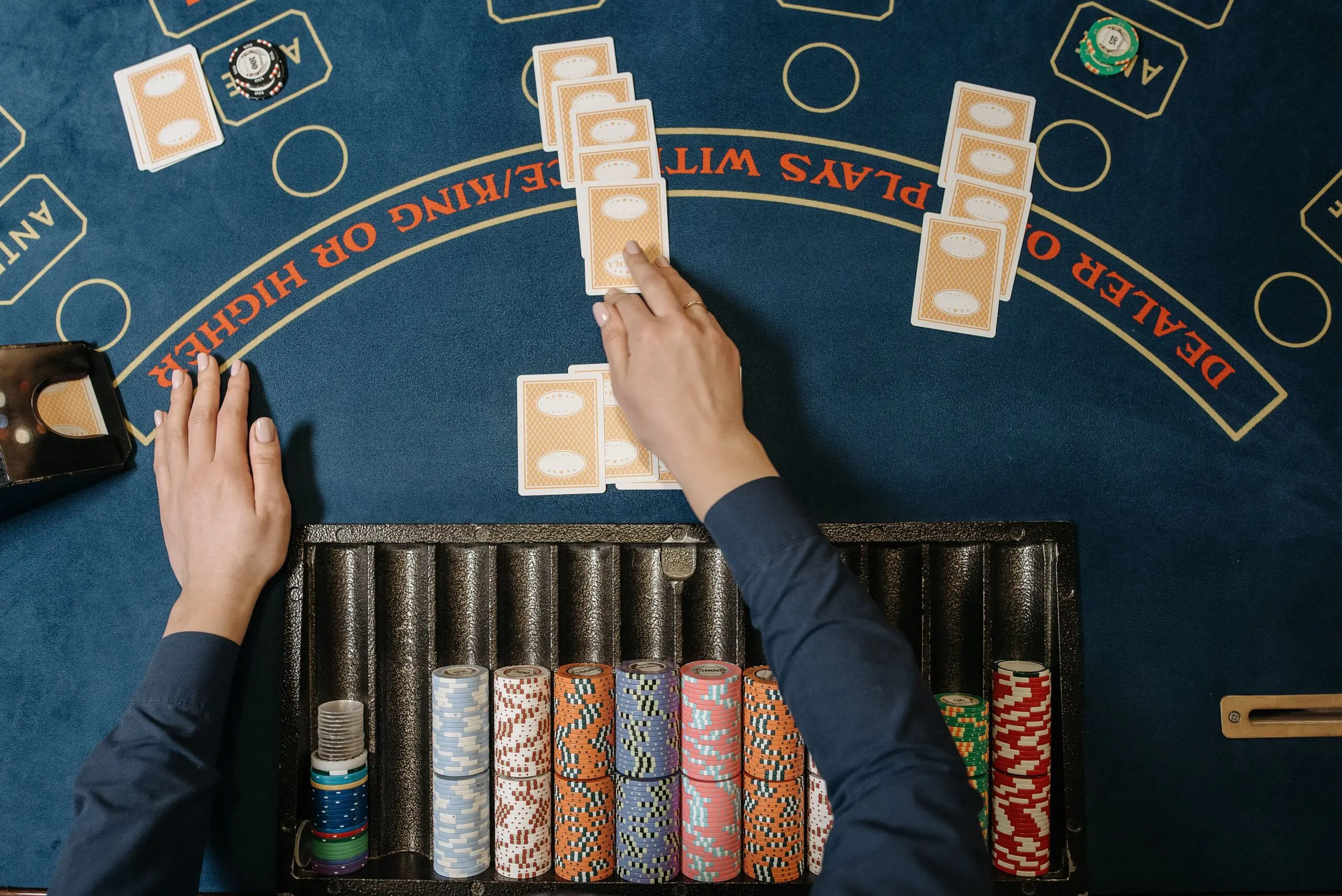
Blackjack basic strategy is the mathematically optimal way to play each hand based on the player’s cards, the dealer’s upcard, and the specific table rules. It does not guarantee a win, and it does not remove the casino’s edge in ordinary play. What it does is minimize expected loss by replacing guesses, hunches, and superstition with probability-based decisions. A player using correct basic strategy will generally face a much lower house edge than someone who improvises. The exact strategy can change depending on whether the dealer hits or stands on soft 17, whether doubling after a split is allowed, how many decks are used, whether surrender is offered, and other rules. This guide explains how blackjack basic strategy works, why common decisions matter, and how to practice without trying to memorize everything at once.
What Blackjack Basic Strategy Is
Basic strategy is a decision table created from the mathematics of blackjack. For every possible player total and dealer upcard, the strategy identifies the play with the best expected value: hit, stand, double down, split, or surrender when available.
The strategy assumes no knowledge of future cards beyond the information visible on the table. It is different from card counting, which adjusts decisions or bet sizing based on deck composition. Basic strategy is the foundation that should be mastered before any advanced technique.
Why Blackjack Has a Lower House Edge Than Many Casino Games
Blackjack is unusual because player decisions affect expected value. In roulette, the result of the spin is not changed by strategy. In blackjack, hitting 16 against a dealer 10 instead of standing can change the expected loss. The ability to double and split also creates opportunities to put more money into favorable situations.
Under favorable rules and correct basic strategy, the house edge can be relatively small compared with many casino games. The exact number depends on rules, so claims such as “blackjack has a 0.5% house edge” should always be tied to a specific game configuration.
Hard Hands vs. Soft Hands
A hard hand is a total that either contains no ace or contains an ace that must count as 1 to avoid busting. A hard 16, for example, can be 10-6 or 9-7. A soft hand contains an ace counted as 11, such as A-6 for soft 17.
Soft hands can often be played more aggressively because hitting cannot bust immediately while the ace still counts as 11. This is why basic strategy treats soft totals differently from hard totals.
Dealer Upcard Drives Many Decisions
The dealer’s visible card is one of the most important pieces of information. Dealer 2 through 6 are often described as weak upcards because the dealer has a meaningful chance of busting while drawing to 17 or higher. Dealer 7 through ace are stronger upcards because the dealer is more likely to make a solid total.
Basic strategy often recommends standing on modest player totals against weak dealer cards and hitting more aggressively against strong dealer cards. The logic is expected value, not fear of busting.
When to Hit
Hitting means taking another card. The decision depends on the player total and dealer upcard. Low totals usually require a hit because standing would lose too often against any completed dealer hand.
On difficult totals such as hard 12 through 16, the correct action changes with the dealer card. Players often make mistakes here because busting feels emotionally worse than standing and losing. Basic strategy ignores the emotional difference and chooses the option with the lower expected loss.
When to Stand
Standing means accepting the current total. Strong totals such as hard 17 or higher generally stand because the risk of busting exceeds the benefit of improving.
Some lower totals also stand against weak dealer upcards. For example, a hard 13 may stand against certain dealer cards because the dealer’s bust probability makes waiting more valuable than risking another card.
Doubling Down
Doubling allows the player to increase the wager, usually by up to the original bet, in exchange for receiving exactly one additional card. It is valuable when the player has a favorable combination of total and dealer upcard.
Players sometimes fail to double because they are afraid of risking more money. That can increase house edge. If the bankroll cannot comfortably make proper doubles, the base bet may be too large.
Splitting Pairs
When the first two cards have the same rank, many blackjack games allow the player to split them into two hands. Each hand receives a second card and an additional wager equal to the original stake.
Some pairs are routinely split because two separate hands have better expected value than the combined total. Others should usually stay together. The classic example is splitting aces and eights under common rules, while tens are generally kept as a strong 20.
Why Splitting Tens Is Usually a Mistake
A total of 20 is one of the strongest blackjack hands. Splitting tens replaces a highly valuable made hand with two uncertain starting hands.
Card counters can face rare index situations where unusual deviations are mathematically justified, but ordinary basic strategy players should not split tens. The dramatic appearance of two possible winning hands does not outweigh the value already held.
Why Splitting Fives Is Usually a Mistake
A pair of fives creates a hard 10, which is a strong doubling opportunity against many dealer upcards. Splitting turns that strong total into two weak hands starting with 5.
Basic strategy therefore treats fives as a total of 10 rather than as a pair to split in common rule sets.
Surrender
Late surrender allows the player to forfeit half the wager and end the hand after the dealer checks for blackjack when applicable. It is useful in a small set of bad situations where losing half is better than playing the full wager at a very poor expectation.
Many casinos do not offer surrender. If it is available, the exact strategy depends on the rules. Ignoring a valuable surrender option slightly increases house edge.
Insurance
Insurance is a side bet offered when the dealer shows an ace. It pays if the dealer has blackjack. For a basic strategy player without card-count information, insurance is generally a negative-expectation wager.
The fact that you have a strong hand such as 20 does not make insurance better. The side bet depends on the probability that the dealer’s hole card is a ten-value card.
Even Money
When the player has blackjack and the dealer shows an ace, the casino may offer even money. Mathematically, this is equivalent to taking insurance on the blackjack.
Basic strategy players generally decline without additional deck-composition information. The guaranteed payout feels safe but usually gives up expected value.
Dealer Hits or Stands on Soft 17
One important table rule is whether the dealer hits or stands on soft 17. Dealer stands on soft 17 is generally better for the player because the dealer cannot improve certain soft totals by drawing.
This rule changes some basic-strategy decisions and house edge. Always use a chart matched to the table rules.
Number of Decks
Single-deck, double-deck, six-deck, and eight-deck games can have different basic-strategy details. Deck count also affects blackjack frequency and card-counting sensitivity.
Do not use a single-deck chart automatically on a six-deck shoe. Most decisions are similar, but some doubles and surrender plays can differ.
Blackjack Payout: 3:2 vs. 6:5
The payout for a natural blackjack is one of the most important rules. Traditional 3:2 pays $15 on a $10 wager. A 6:5 table pays only $12 on the same wager.
That difference significantly increases house edge. A visually attractive 6:5 table can be much worse than a less flashy 3:2 game. Check the felt or posted rules before sitting down.
Double After Split
Double after split, often abbreviated DAS, allows the player to double a hand created after splitting. This is favorable because some split hands become strong doubling opportunities.
When DAS is not allowed, certain pair-splitting decisions change. Another reason the correct strategy chart must match the rules.
Resplitting Aces
Some casinos allow players to split aces again if another ace appears; others permit only one split. Resplitting aces improves player value because aces are strong starting cards.
The rule does not affect every hand, but small favorable rules add up when comparing tables.
Dealer Peek and No-Hole-Card Rules
In many U.S. games, the dealer checks for blackjack when showing an ace or ten-value card before players make additional decisions. In some international games, the dealer may not take a hole card until later.
No-hole-card rules can affect doubling and splitting strategy because additional wagers may be exposed to a later dealer blackjack. Use a strategy chart built for the specific format.
Basic Strategy Does Not Tell You How Much to Bet
Basic strategy determines how to play the hand, not wager size. Flat betting is common for recreational players. Card counters may vary wagers based on count, which is a separate advanced strategy.
Do not increase the bet simply because you won the last hand. Betting progressions do not change the underlying expected value.
Why Side Bets Usually Increase House Edge
Blackjack tables often offer side bets such as Perfect Pairs, 21+3, Lucky Ladies, or progressive jackpots. These can be entertaining but typically carry a higher house edge than the main blackjack game.
Side bets also increase total money at risk per round. A $25 blackjack player adding two $10 side bets is effectively wagering $45 before doubles or splits.
Bankroll Requirements for Correct Basic Strategy
Proper strategy sometimes requires extra wagers through doubles and splits. If you sit with enough money for only a few base bets, you may be unable to make mathematically correct plays.
Choose a base bet that leaves room for multiple splits and doubles. A player who refuses a favorable double because the bankroll is too small is effectively increasing the game’s house edge.
Why “Never Bust” Is a Bad Strategy
Some players stand on every 12 through 16 because they hate busting. This feels safe, but against strong dealer upcards it can lose more often than hitting.
Basic strategy compares expected value, not the emotional pain of a visible bust. Sometimes taking the risk of another card is mathematically better.
Why Copying the Dealer Is Wrong
The dealer must follow fixed rules and cannot double, split, or surrender. Copying the dealer ignores the player’s strategic options and produces poor decisions.
The casino edge partly comes from the fact that players act first and can bust before the dealer. Basic strategy is designed around that structure.
Why Other Players Do Not “Take Your Card” in a Meaningful Way
Players often blame someone who hits a hand “wrong” for changing the next card. The sequence of cards does change, but without knowledge of future cards there is no basis for saying the deviation hurt you more than it helped.
Over time, another player’s basic-strategy mistakes do not systematically increase your house edge. Focus on your own decisions.
How to Memorize Basic Strategy
Break the chart into categories: hard totals, soft totals, and pairs. Learn the obvious decisions first, then focus on borderline hands such as hard 12-16, soft 17-19, and pair splits.
Practice with flash cards or a blackjack trainer. Repetition creates automatic recall so decisions remain accurate under casino pressure.
Use a Strategy Card Where Allowed
Many casinos allow players to consult a printed basic-strategy card at the table as long as it does not slow the game excessively. Policies vary, so ask if unsure.
A card is better than guessing. The goal is accurate execution, not proving you can memorize everything.
Basic Strategy and Online Blackjack
Online RNG blackjack and live-dealer blackjack can use different rules. Check deck count, dealer soft-17 rule, blackjack payout, split rules, and surrender.
Do not assume a familiar-looking online table matches your land-based strategy chart.
Basic Strategy and Card Counting
Card counting starts with perfect basic strategy. The count then identifies a limited set of deviations where composition changes the best decision or betting level.
A counter who frequently makes basic-strategy errors can erase a small theoretical edge. Master the foundation first.
Expected Loss Example
Suppose a blackjack game has a 0.5% house edge under correct strategy and the player wagers $5,000 in total action. The theoretical expected loss is about $25. If poor decisions raise the effective edge to 2%, expected loss becomes about $100.
Actual results can differ dramatically, but the example shows why decision quality matters over volume.
Common Basic Strategy Mistakes
Frequent errors include taking insurance, standing on weak totals against strong dealer cards, failing to double favorable hands, splitting tens, refusing to split eights, and playing 6:5 tables without recognizing the cost.
Most mistakes are driven by emotion or superstition. A strategy chart removes both.
Responsible Gambling and Blackjack
A low house edge does not make blackjack a guaranteed-profit game. Variance can produce long losing streaks even with perfect decisions.
Set a bankroll, choose a conservative bet, and stop when the session limit is reached. Do not chase losses or increase wagers because you believe a win is due.
Frequently Asked Questions About Blackjack Basic Strategy
Does basic strategy guarantee I will win?
No. It minimizes expected loss for the rule set but cannot control random card sequences.
Is basic strategy the same for every blackjack table?
No. Deck count, soft-17 rule, surrender, double-after-split, and other rules can change some decisions.
Should I take insurance?
Basic strategy generally declines insurance because the side bet is usually negative EV without card-count information.
Why is 3:2 blackjack better than 6:5?
A natural blackjack receives a larger payout at 3:2, materially reducing the house edge.
Can I use a strategy card at the table?
Many casinos allow it, but policies vary. Ask the dealer or floor staff if unsure.
Final Takeaway
Blackjack basic strategy is the foundation of intelligent blackjack play. It uses probability to determine when to hit, stand, double, split, and surrender, reducing the house edge compared with guesswork.
Choose favorable table rules, size the bankroll so you can make proper doubles and splits, and practice until decisions become automatic. Continue with Blackjack Strategy, the Blackjack Edge Trainer, and Advantage Play at Santi Casino Quest. Blackjack involves risk, and even perfect strategy can lose in the short term.
Next SCQ guide: Blackjack True Count Explained.

Leave a Reply